Some spirits are simply drunk; others carry you to a place. Ouzo and tsipouro belong firmly in the second group. They are not just drinks — they are part of our national identity, of a tradition passed down through generations, and of the very flavour of our land: the sun, the vineyard, the sea.
Part of who we are
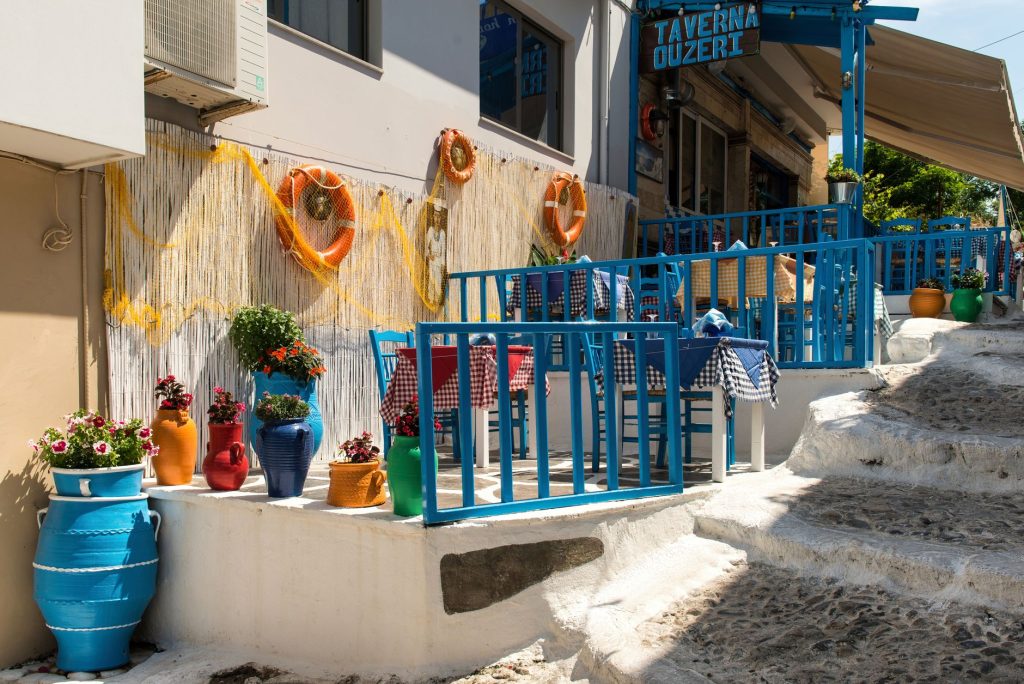
In every corner of Greece, from the little harbour of Mytilene to a mountain village in Thessaly, a glass of ouzo or tsipouro is shorthand for hospitality. It is the drink of company, of the slow afternoon, of conversation that is in no hurry. An entire culture grew around it — the ouzeri, the tsipourádika, the endless small plates. You don’t down it in one gulp; you take your time, with water, with friends. And that is exactly where its value lies: it offers not merely alcohol, but a moment to share.
Tsipouro: the spirit of the pomace
Tsipouro is born where wine ends. After the grapes are pressed and fermented, what remains is the pomace (stemfyla) — the skins, pips and stems. Instead of being discarded, it is distilled. The pomace goes into a copper still, the ambykas, is heated, and the alcohol vapours condense back into liquid. In good tsipouro the distillation is done twice, for purity and aroma.
There are two schools: tsipouro without anise, which lets the grape’s character shine through, and tsipouro with anise, more aromatic. Its strength usually sits around 40-45% ABV. On the mainland — Thessaly, Macedonia, Epirus — we call it tsipouro; in Crete it becomes tsikoudiá (raki). Names such as “Tsipouro of Thessaly” and “Tsipouro of Tyrnavos” are protected geographical indications. And every autumn the “firing of the still” remains a celebration: friends, fire, mezedes and the first, still-warm tsipouro of the year.
Ouzo: the alchemy of anise
Ouzo takes a different road. It begins not from pomace but from pure ethyl alcohol of agricultural origin, which is re-distilled in copper stills together with botanicals. The lead is anise; beside it often come fennel, Chios mastic, coriander, liquorice and cardamom. This aromatic distillate — the “soul” of the ouzo — gives it its character. The finest ouzos are 100% distilled, unlike cheaper ones that simply blend ready alcohol with flavouring.
Its strength ranges from 37.5% to 46% (usually 40%). Under European law ouzo is an exclusively Greek product, with protected names such as “Ouzo of Mytilene” and the celebrated ouzo of Plomari. And it has its own piece of magic: add water or ice and the clear liquid turns cloudy, milky-white. It isn’t magic — it is the anethole from the anise which, losing the alcohol that kept it dissolved, forms tiny droplets that scatter the light. That louche is the signature of genuine ouzo.
The ritual
Neither ouzo nor tsipouro is meant to be rushed. They call for water, a cube of ice, and above all a meze: grilled octopus, fresh seafood, olives, feta, a tomato from the garden. These are spirits of the table, not the bar — drinks that ask for company and time. You don’t knock them back; you keep them company.
Ouzo and tsipouro are not merely two Greek spirits. They are the memory of the vineyard, the craft of the distiller, and the taste of a land that knows how to celebrate with measure and soul. Every sip carries sun, sea and tradition — a piece, in other words, of who we are.
pkv @ DRINKS.gr Editorial · June 2026