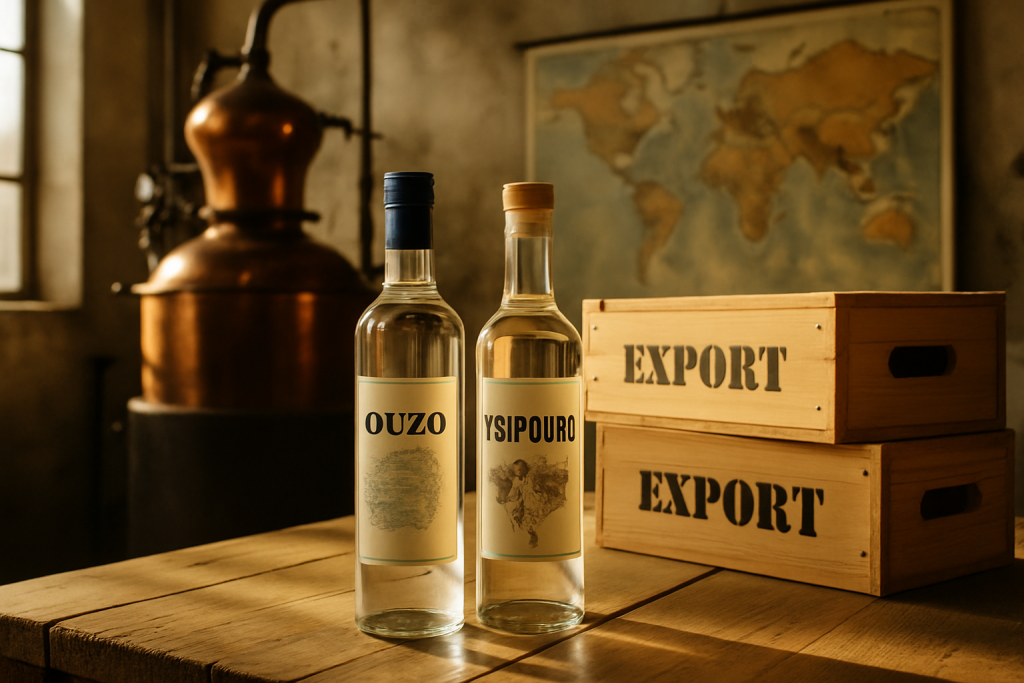
Greece’s traditional distillates — ouzo, tsipouro and tsikoudia — are entering 2026 with real momentum. National exports of Greek spirits reached €114.5 million in 2024, up from €106.2 million a year earlier, clearing the €100-million mark for a second consecutive year and confirming a decade-long climb of roughly 16.6%.
The volume tells the same story: exports rose about 3% to 13.9 million litres of pure alcohol, while total production climbed 3.2% to 21.4 million litres. Even domestic consumption — long in retreat — ticked up 2% to 7.3 million litres, a rare positive signal for the home market.
A category built on origin
What sets the Greek category apart is provenance. Products carrying a Protected Designation of Origin or Geographical Indication — among them tsipouro, tsikoudia, Chios mastiha and the citrus liqueurs of Naxos — account for more than 70% of production and nearly 80% of exports. Origin, in other words, is doing the heavy commercial lifting.
The industry remains strikingly artisanal. Roughly 300 production units, overwhelmingly small and family-run, are dispersed across the mainland and islands, anchoring rural employment from Lesvos to Crete.
The cocktail of challenges
Momentum, however, meets headwinds. Producers point to a high excise tax (ΕΦΚ) that squeezes pricing, rising energy and operating costs, and softer demand from a Gen Z that drinks less and increasingly reaches for non-alcoholic options. Geopolitical friction and climate volatility add to the mix.
The sector’s asks are consistent: modernise the legislative framework, cut bureaucracy, align the excise burden closer to the European average, and fund coordinated promotion abroad. If those levers move, 2026 could turn a good year into a structurally better decade.